

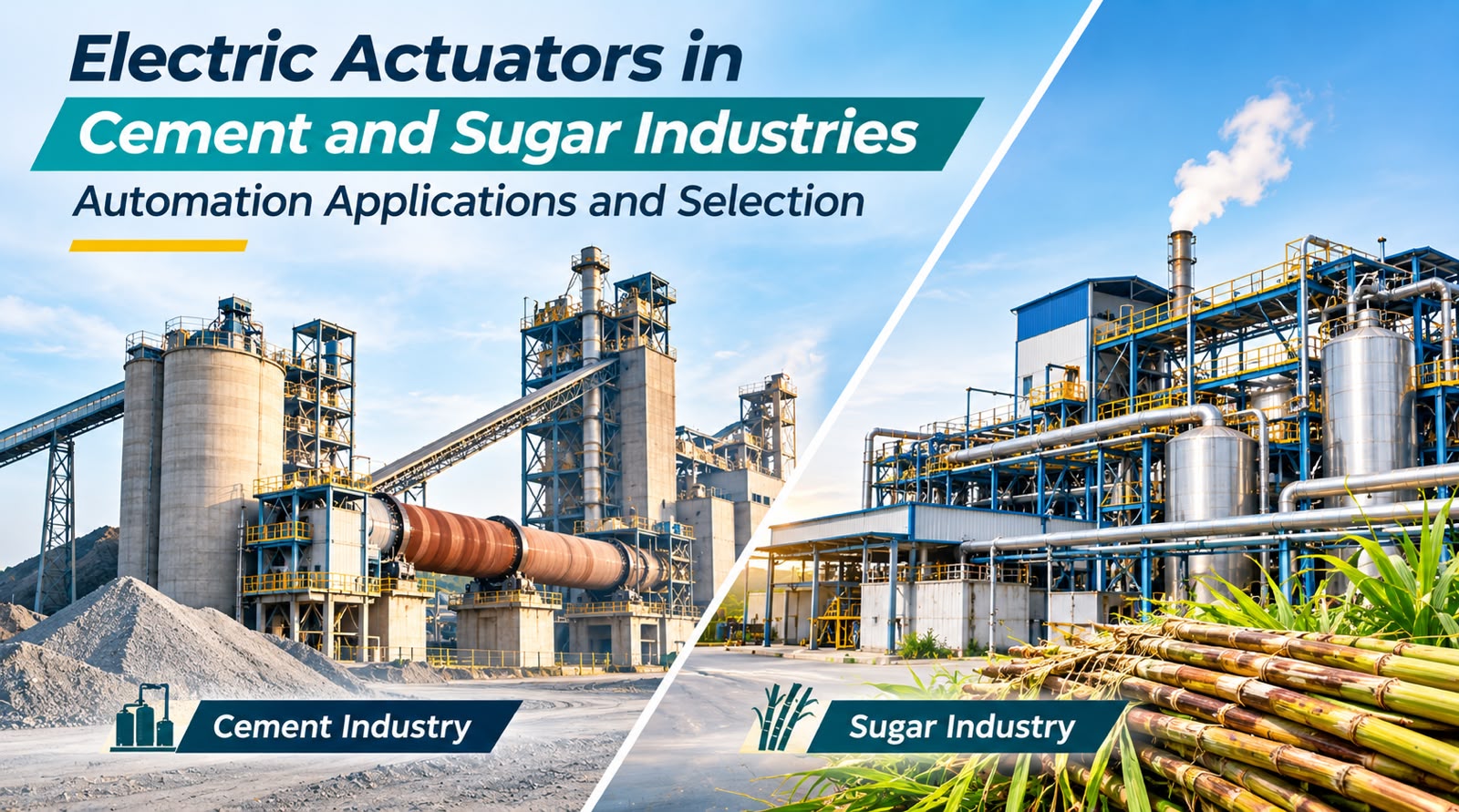
Electric Actuators in Cement and Sugar Industries: Automation Applications and Selection
- Industrial Automation / Actuators
- Nov 25, 2026
- 15 Views
Electric Actuators in Cement and Sugar Industries: Automation Applications and Selection
Cement and sugar manufacturing industries depend on complex industrial processes involving pipelines, valves, conveyors, boilers, furnaces, cooling systems and material-handling equipment. These operations require reliable control of air, water, steam, fuel and other process materials.
As manufacturing facilities move toward greater automation, electric actuators have become important components of industrial valve control systems.
Electric actuators convert electrical energy into mechanical movement, allowing industrial valves and compatible mechanisms to operate automatically. They help control material flow, regulate process conditions, reduce manual intervention and support centralized plant operations.
In cement manufacturing, electric actuators are used in applications associated with kiln systems, dust collection, cooling circuits and material handling. In sugar processing, they support valve automation in juice processing, evaporation, steam distribution, boiler systems and other production utilities.
In this guide, we explore the applications of industrial electric actuators in cement and sugar industries, their benefits, available configurations and important selection factors.
1. What Are Industrial Electric Actuators?
An industrial electric actuator is an electromechanical device that converts electrical energy into controlled mechanical movement.
It is generally installed on a compatible industrial valve or mechanism to automate opening, closing or positioning.
Depending on the application, electric actuators provide different types of movement:
Quarter-turn movement
Multi-turn movement
Linear movement
Angular movement
Electric actuators can be configured for on-off, inching or modulating operation, depending on the model.
They can also integrate with suitable PLC, SCADA and DCS systems for centralized monitoring and control.
In cement and sugar manufacturing, electric actuators are useful wherever industrial processes require automated valve operation or controlled mechanical movement.
2. Applications of Electric Actuators in the Cement Industry
Cement manufacturing involves several stages, including raw material preparation, grinding, kiln processing, clinker cooling, material conveying and final cement production.
These processes involve challenging industrial conditions such as dust, heat, vibration and frequent equipment operation.
Electric actuators can automate compatible valves and dampers across different production stages.
A. Kiln and Furnace Control Systems
Rotary kilns operate at high temperatures and require carefully managed process conditions.
Electric actuators can operate compatible valves and dampers associated with supporting fuel, air and utility systems.
Applications may include:
Fuel line isolation
Combustion air control
Supporting process dampers
Auxiliary pipeline automation
The actuator must be selected according to the valve or damper mechanism, required torque, operating conditions and installation environment.
B. Dust Collection and Emission Control
Cement manufacturing generates significant quantities of dust during crushing, grinding, conveying and material processing.
Dust collection equipment, including bag filters and associated extraction systems, helps control particulate emissions.
Electric actuators can operate compatible dampers and valves in:
Dust collection systems
Air distribution lines
Filter isolation arrangements
Exhaust systems
Ventilation networks
Suitable enclosure protection and mechanical design are important in dusty industrial environments.
C. Raw Material Handling Systems
Raw material handling involves transporting limestone, clay, gypsum and other materials throughout the manufacturing facility.
Electric actuators can automate compatible valves and dampers in supporting pneumatic conveying, air distribution and process utility systems.
Applications include:
Material transfer systems
Air control dampers
Pipeline isolation
Supporting process equipment
D. Cooling and Exhaust Systems
Cooling and exhaust arrangements help manage operating temperatures and process air movement throughout cement plants.
Electric actuators can operate compatible butterfly valves, dampers and other flow-control equipment.
These applications can include:
Clinker cooling systems
Exhaust air control
Cooling water pipelines
Ventilation systems
Auxiliary process circuits
E. Hydraulic and Pneumatic Systems
Cement plants use hydraulic and pneumatic equipment in different mechanical and production operations.
Electric actuators can automate suitable valves in supporting hydraulic and pneumatic systems where electrically operated valve control is required.
The complete valve and actuator arrangement must be selected according to pressure, flow and mechanical requirements.
3. Applications of Electric Actuators in the Sugar Industry
Sugar manufacturing involves several interconnected processes, including cane preparation, juice extraction, clarification, evaporation, crystallization, centrifuging and sugar handling.
Steam and water management are particularly important throughout the production process.
Electric actuators help automate compatible valves in these systems.
A. Cane Preparation and Juice Extraction
Sugarcane passes through preparation equipment before juice extraction.
The extraction stage uses crushing or milling equipment to separate juice from fibrous material.
Electric actuators may operate compatible valves in supporting:
Water supply lines
Process utility pipelines
Equipment isolation systems
Supporting fluid circuits
B. Juice Heating and Clarification
Extracted juice undergoes heating and clarification to remove suspended impurities.
This stage involves the controlled movement of process liquids, heating media and chemicals.
Electric actuators can operate compatible valves used in:
Juice transfer pipelines
Heating circuits
Chemical dosing arrangements
Process isolation systems
C. Evaporation Systems
Evaporation removes excess water from clarified juice to increase its concentration.
Steam is commonly used as a heating medium in industrial evaporator arrangements.
Electric actuators can operate compatible valves in:
Steam distribution lines
Condensate pipelines
Process water circuits
Evaporator isolation arrangements
Supporting bypass lines
D. Boiler and Steam Distribution Systems
Boilers supply steam for different sugar manufacturing processes.
Electric actuators can automate compatible valves associated with boiler auxiliaries, steam distribution and supporting water systems.
Applications include:
Boiler feedwater lines
Steam isolation valves
Condensate return systems
Auxiliary water pipelines
Utility distribution networks
The selected actuator and valve must meet the actual pressure and temperature requirements.
E. Crystallization and Centrifuging
During crystallization, concentrated syrup is processed to form sugar crystals.
Centrifuges separate sugar crystals from the remaining liquid.
Electric actuators can operate compatible valves in supporting process pipelines, water circuits and utility systems.
F. Water and Effluent Management
Sugar factories use water in multiple manufacturing and cleaning operations.
They also generate wastewater that requires appropriate collection and treatment.
Electric actuators can automate compatible valves in:
Water distribution networks
Wastewater treatment systems
Effluent pipelines
Pumping stations
Storage tanks
Treatment plant isolation systems
4. Types of Industrial Electric Actuators Used in Cement and Sugar Plants
Different industrial valves require different types of movement. Selecting the correct actuator configuration is important for efficient operation.
A. Quarter-Turn Electric Actuators
Quarter-turn actuators provide approximately 90 degrees of rotary movement.
They are commonly used with:
Butterfly valves
Ball valves
Plug valves
Compatible rotary dampers
In cement plants, they can be used in dust collection, cooling and air control applications.
In sugar plants, they may operate compatible pipeline isolation and utility valves.
B. Multi-Turn Electric Actuators
Multi-turn actuators provide multiple rotations of the output shaft.
They are commonly used with:
Gate valves
Globe valves with suitable multi-turn arrangements
Sluice gates
Other compatible multi-turn valves
These actuators are useful in steam, water and industrial pipeline applications.
SDTORK offers multi-turn actuator configurations, including the SD-3000 series and supplementary gearbox arrangements.
C. Linear Electric Actuators
Linear electric actuators provide straight-line movement.
They are commonly used with:
Globe valves
Diaphragm valves
Compatible control valves
Dosing equipment
Other linear mechanisms
They are suitable where the valve requires controlled linear travel and a specified operating thrust.
Explore the SDTORK Linear Electric Actuator Range.
5. On-Off and Modulating Electric Actuators in Manufacturing Plants
Electric actuators can be configured for different control requirements.
On-Off Electric Actuators
On-off actuators move valves between defined positions, generally fully open and fully closed.
Applications include:
Pipeline isolation
Water distribution
Steam isolation
Equipment shutdown
Utility flow switching
Modulating Electric Actuators
Modulating actuators allow valves to move to intermediate positions according to the control signal.
They are useful for:
Process flow adjustment
Airflow regulation
Pressure management
Compatible temperature control arrangements
Automated process regulation
The actuator and valve must be suitable for the required operating duty and control characteristics.
For more information, read our related article:
Modulating vs On-Off Electric Actuators: Working, Applications and Differences.
6. Benefits of Industrial Electric Actuators in Cement and Sugar Industries
1. Improved Process Automation
Electric actuators automate compatible valve operations and support coordinated industrial processes.
2. Remote Valve Operation
Operators can control suitable actuators from centralized control stations, reducing the need for manual operation at individual locations.
3. Consistent Valve Positioning
Compatible actuators provide repeatable opening, closing and positioning according to the control requirements.
4. Suitable for Demanding Environments
Industrial actuator configurations can be selected with suitable enclosure protection and construction for dusty, humid and outdoor installations.
5. Integration with Automation Systems
Compatible models can integrate with PLC, SCADA and DCS systems through suitable control and feedback arrangements.
6. Reduced Manual Intervention
Automated operation can reduce routine manual valve handling across large manufacturing facilities.
7. Flexible Application Options
Quarter-turn, multi-turn and linear configurations provide options for different industrial valve types.
7. How to Select the Right Industrial Electric Actuator
Selecting an actuator for cement or sugar manufacturing requires evaluating the application and operating environment.
1. Identify the Valve Type
Determine whether the valve is a butterfly valve, ball valve, gate valve, globe valve or another configuration.
The valve type determines the required movement.
2. Calculate Required Torque or Thrust
The actuator must provide sufficient torque or thrust to operate the valve under actual conditions.
Consider:
Valve design
Differential pressure
Operating friction
Seating and unseating torque
Mechanical losses
Required safety margin
Read our detailed guide: How to Select and Size an Electric Actuator: Torque Calculation Guide.
3. Evaluate Environmental Conditions
Cement plants can expose equipment to dust, vibration and elevated temperatures.
Sugar plants may involve moisture, humidity, washdown conditions and chemical exposure.
Check the actuator's enclosure protection and suitability for the actual installation environment.
4. Check Operating Frequency
Determine how frequently the valve will operate.
Confirm that the actuator duty rating matches the expected number of operating cycles.
5. Select the Correct Control Mode
Identify whether the application requires on-off, inching or modulating operation.
6. Verify Electrical Supply
Check the available voltage, phase and frequency.
7. Confirm Automation Compatibility
Verify the required control signals, feedback, communication interfaces and integration with the plant's automation system.
8. Consider Maintenance Requirements
Evaluate accessibility, installation conditions, service requirements and availability of suitable replacement components.
8. Why Choose SDTORK Electric Actuators for Cement and Sugar Industries?
SDTORK Controls Pvt. Ltd. designs and manufactures electric actuators for industrial valve automation across demanding manufacturing environments.
Its actuator portfolio includes quarter-turn, multi-turn and linear configurations for different industrial applications.
Relevant actuator options include:
SD-3000 + FWG Series: Multi-turn weatherproof electric actuators with supplementary full-turn worm gearboxes. The published product information identifies cement industries among their applications.
SD-3000 Series: Multi-turn weatherproof electric actuators for compatible industrial valve applications.
SD-3000 + BG Series: Multi-turn actuators with supplementary bevel gearboxes for applications requiring different output torque arrangements.
SD-2000 Series: Linear electric actuators for compatible globe valves, diaphragm valves and dosing pumps.
FSD Series: Flameproof actuator configurations for installations requiring appropriate hazardous-area protection.
Depending on the selected model, available configurations include different torque capacities, control modes and enclosure protection options.
Explore the SDTORK Industrial Electric Actuator Range to review actuator configurations and technical specifications.
For industry-specific applications, visit:
The correct actuator should always be selected according to valve requirements, process conditions, operating duty and installation environment.
9. Frequently Asked Questions
What are industrial electric actuators used for in cement plants?
They are used to automate compatible valves and dampers in kiln supporting systems, cooling circuits, dust collection, exhaust systems and material-handling processes.
Where are electric actuators used in sugar industries?
They can be used in juice processing, evaporation, steam distribution, boiler auxiliaries, condensate systems, water management and effluent treatment.
Which electric actuator is suitable for cement industries?
Quarter-turn actuators are suitable for compatible butterfly and ball valves, while multi-turn actuators are used with gate valves and other multi-turn arrangements. Linear actuators are used where straight-line movement is required.
Can electric actuators operate in dusty cement plant environments?
Yes, provided the selected actuator has suitable enclosure protection and is designed for the actual dust, temperature and installation conditions.
Are electric actuators suitable for sugar mills?
Yes. Electric actuators can automate compatible valves in process pipelines, steam systems, water distribution and wastewater management.
Can industrial electric actuators integrate with PLC and SCADA?
Compatible actuator configurations can integrate with PLC and SCADA systems through suitable control interfaces, feedback arrangements and communication options.
What is the difference between quarter-turn and multi-turn actuators?
Quarter-turn actuators provide approximately 90 degrees of rotary movement, whereas multi-turn actuators provide multiple rotations of the output shaft.
How do I select an industrial electric actuator?
Consider the valve type, torque or thrust requirement, pressure, temperature, operating frequency, electrical supply, control mode and environmental protection.
Conclusion
Electric actuators support industrial automation across cement and sugar manufacturing by providing controlled operation of compatible valves and dampers.
In cement plants, they are useful in cooling systems, dust collection, exhaust arrangements, material handling and supporting process utilities.
In sugar factories, they support automation in juice processing, evaporation, steam distribution, boiler auxiliaries and water management.
Selecting the correct actuator requires understanding the valve mechanism, torque or thrust requirements, environmental conditions, control mode and electrical specifications.
With suitable actuator selection and integration, manufacturers can improve process coordination, reduce manual intervention and support consistent industrial operations.
Looking for industrial electric actuators for your cement plant or sugar mill?
Explore the SDTORK Industrial Electric Actuator Range and discover actuator configurations for different valve automation requirements.
Contact SDTORK Controls Pvt. Ltd. to discuss your application and actuator selection requirements.
Related Posts
- Nov 30, 2026
- SDTORK
- 10
Electric Actuator Price in India: Factors Affecting Cost and Selection
Explore More
- Nov 27, 2026
- SDTORK
- 10
Electric Actuators for Hydrogen and Defence Applications: Requirements and Selection
Explore More
- Nov 23, 2026
- SDTORK
- 10