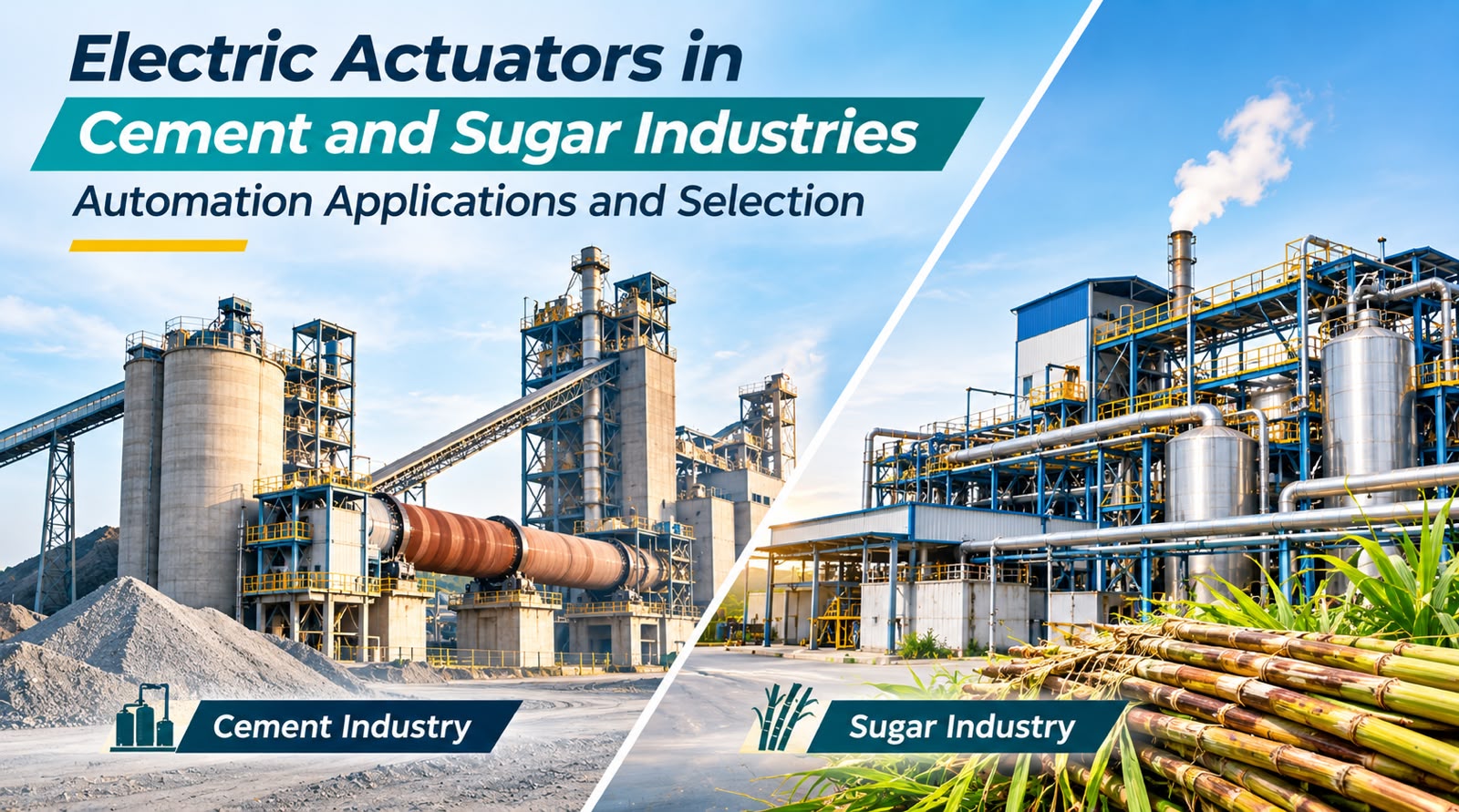

Electric Actuators in Power Plants: Applications in Industrial Valve Automation
- Industrial Automation / Actuators
- Nov 23, 2026
- 13 Views
Electric Actuators in Power Plants: Applications in Industrial Valve Automation
Power plants depend on complex systems of pipelines, boilers, turbines, cooling equipment and industrial valves to generate and distribute electricity. Every stage of power generation requires controlled movement of steam, water, fuel and other process fluids.
Reliable valve operation is essential for maintaining process stability, managing pressure, controlling flow and supporting safe plant operations.
Electric actuators play an important role in power plant automation by providing controlled mechanical movement to operate industrial valves. They allow operators to automate valve operations, manage equipment remotely and integrate compatible valve systems with centralized plant control networks.
From boiler feedwater systems and cooling water circuits to steam pipelines and auxiliary equipment, electric actuators support several important power generation processes.
In this guide, we explore the applications of electric actuators in power plants, their operating principles, benefits, actuator types and important selection considerations.
1. What Is an Electric Actuator in a Power Plant?
An electric actuator is an electromechanical device that converts electrical energy into mechanical movement to operate a valve or another compatible mechanism.
In power plants, electric actuators are used to automate industrial valves that control the movement of water, steam and other process fluids.
Depending on the valve configuration, electric actuators can provide:
Quarter-turn movement
Multi-turn movement
Linear movement
On-off valve operation
Modulating valve positioning
They can receive operating commands from local control panels, PLCs, DCS systems and other compatible industrial automation equipment.
Electric actuators are commonly used with butterfly valves, ball valves, gate valves, globe valves and other compatible valve arrangements.
The selection depends on the valve operating mechanism, required torque or thrust, process conditions and control requirements.
2. Why Are Electric Actuators Important in Power Plants?
Power generation facilities contain several interconnected systems that must operate in coordination.
Valves control the movement of fluids throughout these systems. Manual operation can become difficult when valves are distributed across large installations or when frequent adjustments are required.
Electric actuators help automate these operations.
Automated Valve Operation
Electric actuators provide controlled opening, closing and positioning of compatible industrial valves.
Remote Operation
Operators can control compatible actuators from centralized control rooms, reducing the need for manual operation at individual valve locations.
Process Control
Modulating actuators can position compatible valves at intermediate positions to support process control requirements.
Integration with Automation Systems
Electric actuators can be integrated with PLC and DCS systems using suitable electrical interfaces, feedback arrangements and communication options.
Operational Consistency
Automated operation helps maintain repeatable valve movements according to programmed operating sequences.
3. Applications of Electric Actuators in Power Plants
Electric actuators are used across different power plant systems depending on valve type, operating conditions and automation requirements.
A. Boiler Feedwater Systems
Boiler feedwater systems supply water to boilers under controlled operating conditions.
Maintaining the required water supply is important for boiler operation and overall power generation.
Electric actuators can operate compatible valves installed in:
Feedwater pipelines
Water supply arrangements
Isolation systems
Bypass lines
Supporting process circuits
Linear electric actuators may be suitable for compatible globe valves and other valves requiring linear movement.
The selection must consider required thrust, valve characteristics, operating pressure and temperature.
B. Steam Pipeline Systems
Steam plays a central role in thermal power generation.
Steam pipelines transport steam between boilers, turbines and other process equipment.
Electric actuators can automate compatible valves used for isolation and process control in steam-related systems.
Applications may include:
Steam isolation valves
Auxiliary steam lines
Bypass arrangements
Supporting process pipelines
Compatible flow-control valves
Actuator and valve selection must account for the actual steam temperature, pressure, valve design and installation conditions.
C. Cooling Water Systems
Cooling water systems remove heat from power plant equipment and support thermal management.
Electric actuators can operate compatible valves in:
Cooling water inlet lines
Cooling water outlet lines
Circulation pipelines
Pumping stations
Heat exchanger isolation arrangements
Quarter-turn actuators are commonly suited to compatible butterfly and ball valves used in these systems.
D. Condensate Systems
Condensate systems collect and transfer condensed steam back toward the feedwater cycle.
Electric actuators may be used to automate compatible valves in condensate collection, transfer and isolation arrangements.
Their application depends on the valve type, process pressure, temperature and operating requirements.
E. Turbine Auxiliary Systems
Steam turbines are essential components of many thermal power plants.
Various auxiliary systems support turbine operation, including lubrication, cooling, drainage and associated fluid handling.
Electric actuators can operate compatible valves within selected auxiliary process systems.
These applications may include:
Auxiliary water lines
Cooling circuits
Drainage systems
Equipment isolation
Supporting pipeline arrangements
Critical turbine protection and trip functions must use the control and safety arrangements specified by the plant design. A general-purpose electric actuator should not be assumed to perform a safety function without the required engineering qualification.
F. Ash Handling Systems
Coal-fired power plants generate ash that must be collected and transported through dedicated handling systems.
Electric actuators may operate compatible valves and dampers in ash handling and associated utility systems.
Applications can include:
Pipeline isolation
Ash handling equipment
Air control dampers
Supporting process mechanisms
The selected equipment must be appropriate for dust exposure, operating conditions and the required duty.
G. Fuel and Auxiliary Utility Systems
Power plants use different auxiliary systems to support generation processes.
Electric actuators may be installed in compatible valves used for:
Fuel transfer systems
Utility water pipelines
Compressed air systems
Service water networks
Auxiliary process isolation
Where combustible gases, fuels or hazardous atmospheres are present, the complete equipment installation must meet the applicable hazardous-area requirements.
4. Types of Electric Actuators Used in Power Plants
Different industrial valves require different forms of movement. Selecting the correct actuator configuration is important for reliable operation.
A. Quarter-Turn Electric Actuators
Quarter-turn actuators provide approximately 90 degrees of rotary movement.
They are commonly used with:
Butterfly valves
Ball valves
Plug valves
Rotary dampers
They are suitable for compatible cooling water, pipeline isolation and auxiliary system applications.
Explore the SDTORK Quarter-Turn Electric Actuator Range for different industrial valve automation configurations.
B. Multi-Turn Electric Actuators
Multi-turn actuators provide multiple rotations of the output shaft.
They are commonly used with:
Gate valves
Globe valves with suitable multi-turn arrangements
Sluice gates
Other compatible multi-turn valves
These actuators are useful where valve operation requires several rotations.
SDTORK offers multi-turn actuator configurations, including the SD-3000, SD-3001 and SD-3002 series.
C. Linear Electric Actuators
Linear electric actuators produce straight-line movement.
They are commonly used with:
Globe valves
Diaphragm valves
Compatible control valves
Dosing equipment
Other linear mechanisms
These actuators are particularly relevant where a valve requires controlled linear travel and specified thrust.
Explore the SDTORK Linear Electric Actuator Range.
5. On-Off vs Modulating Actuators in Power Plant Applications
Electric actuators can operate in different control modes depending on the requirements of the power plant process.
On-Off Electric Actuators
On-off actuators move valves between defined operating positions, generally fully open and fully closed.
They are commonly used for:
Pipeline isolation
Cooling water isolation
Auxiliary water systems
Equipment isolation
Automated valve switching
Modulating Electric Actuators
Modulating actuators allow compatible valves to move to intermediate positions.
They can receive suitable control signals to adjust valve positioning according to process requirements.
Applications may include:
Flow regulation
Pressure control
Process water adjustment
Compatible bypass arrangements
Other controlled process applications
The actuator must be specifically configured and rated for the required modulation duty.
For a deeper understanding, read our related article on Modulating vs On-Off Electric Actuators: Working, Applications and Differences.
6. Benefits of Electric Actuators in Power Generation
Electric actuators offer several benefits when correctly selected and integrated into power plant automation systems.
1. Improved Automation
Electric actuators automate valve movement and help coordinate operations across different plant systems.
2. Remote Valve Control
Compatible actuators allow operators to control valves from centralized operating stations.
3. Accurate Positioning
Modulating actuator configurations can support intermediate valve positioning where required.
4. Reduced Manual Intervention
Automated valve operation reduces the need for operators to manually access every installation point.
5. Integration with Industrial Control Systems
Suitable actuator configurations can integrate with PLC and DCS systems for coordinated plant operation.
6. Multiple Actuator Configurations
Quarter-turn, multi-turn and linear configurations provide options for different industrial valve mechanisms.
7. Environmental Protection Options
Power plant installations may involve dust, moisture, vibration, outdoor exposure and elevated ambient temperatures.
Selecting an actuator with suitable enclosure protection and environmental specifications is important for reliable operation.
SDTORK offers weatherproof and flameproof actuator configurations. The exact protection rating and suitability must be verified against the selected model and installation conditions.
7. How to Select the Right Electric Actuator for a Power Plant
Selecting an electric actuator requires careful evaluation of the valve and operating environment.
1. Identify the Valve Type
Determine whether the application involves a butterfly valve, ball valve, gate valve, globe valve or another configuration.
The valve design determines the required movement.
2. Calculate Torque or Thrust Requirements
The actuator must provide sufficient torque or thrust to operate the valve under actual process conditions.
Important factors include:
Valve size and design
Operating pressure
Differential pressure
Fluid characteristics
Seating and unseating requirements
Mechanical friction
Required safety margin
For a detailed guide, refer to How to Select and Size an Electric Actuator: Torque Calculation Guide.
3. Check Temperature and Pressure Conditions
Power plants may involve high-temperature steam, pressurized water and demanding operating conditions.
Verify the complete valve and actuator assembly's suitability for the application.
Do not select an actuator based only on nominal pipeline size.
4. Determine the Required Control Mode
Establish whether the valve requires on-off operation, inching or continuous modulating control.
Confirm that the actuator is rated for the required operating frequency and duty cycle.
5. Verify Electrical Requirements
Check the available supply voltage, phase, frequency and electrical connection requirements.
6. Evaluate Environmental Conditions
Consider dust, moisture, ambient temperature, vibration, corrosion and installation location.
7. Check Automation Compatibility
Determine whether the actuator needs:
Remote open and close commands
Position feedback
Limit switch indication
Modulating input
PLC or DCS integration
Communication protocol support
For hazardous locations, verify the required area classification and certification for the complete installation.
8. Why Choose SDTORK Electric Actuators for Power Plant Applications?
SDTORK Controls Pvt. Ltd. designs and manufactures electric actuators for industrial valve automation across multiple industries, including power generation.
Its published actuator portfolio includes quarter-turn, multi-turn and linear electric actuator configurations for different valve operating requirements.
Relevant actuator families include:
SD-3001 Series: A multi-turn weatherproof electric actuator listed for power, energy, nuclear, water, marine, chemical and general process industries.
SD-3000 Series: Multi-turn weatherproof electric actuators available in different torque configurations.
SD-3000 + Gearbox Series: Multi-turn configurations with supplementary bevel or worm gearboxes for applications requiring different output torque arrangements.
SD-2000 Series: Linear electric actuator configurations for compatible globe valves and other linear applications.
FSD Series: Flameproof actuator options for installations where the appropriate hazardous-area protection is required.
Explore the SDTORK Industrial Electric Actuator Range to review available actuator configurations and product specifications.
The correct model should be selected according to valve requirements, process conditions, electrical supply, control mode and installation environment.
9. Frequently Asked Questions
What are electric actuators used for in power plants?
Electric actuators are used to automate compatible industrial valves in cooling water systems, boiler feedwater arrangements, steam pipelines, condensate systems, auxiliary utilities and other process applications.
Which electric actuator is suitable for power plants?
The suitable actuator depends on the valve design. Quarter-turn actuators are used with compatible butterfly and ball valves, multi-turn actuators with gate valves and other multi-turn valves, and linear actuators with compatible globe and control valves.
Are electric actuators used in thermal power plants?
Yes. Electric actuators can automate valves in cooling water, feedwater, condensate and auxiliary systems within thermal power plants.
Can electric actuators control steam valves?
Electric actuators can operate compatible steam valves when the complete valve and actuator assembly is correctly selected for the pressure, temperature, torque or thrust and operating conditions.
Can electric actuators integrate with DCS systems?
Yes. Compatible electric actuators can integrate with distributed control systems through suitable control interfaces, feedback arrangements and communication options.
What is the difference between a quarter-turn and multi-turn actuator?
A quarter-turn actuator provides approximately 90-degree rotary movement. A multi-turn actuator provides multiple rotations of the output shaft to operate valves requiring several turns.
Are flameproof electric actuators required in power plants?
Not everywhere. Flameproof actuators are required where the installation is classified as a hazardous area and the equipment must meet the applicable protection requirements. The classification must be determined through the plant's hazardous-area assessment.
How do I calculate the torque required for an electric actuator?
Torque selection depends on valve design, differential pressure, friction, operating conditions and manufacturer valve torque data. The selected actuator should provide the required operating torque with an appropriate engineering margin.
Conclusion
Electric actuators are important components of industrial valve automation in power generation facilities.
From cooling water and boiler feedwater systems to condensate pipelines and auxiliary equipment, they help automate compatible valves and support coordinated plant operations.
Selecting the right actuator requires understanding the valve configuration, torque or thrust requirements, operating conditions, control mode, electrical supply and environmental protection requirements.
With the correct actuator configuration and suitable integration, power plants can improve valve automation, reduce manual intervention and support consistent process operation.
Looking for electric actuators for your power plant application?
Explore the SDTORK Electric Actuator Range for quarter-turn, multi-turn and linear actuator configurations designed for industrial valve automation.
Contact SDTORK Controls Pvt. Ltd. to discuss your valve type, operating conditions and actuator selection requirements.
Related Posts
- Nov 30, 2026
- SDTORK
- 10
Electric Actuator Price in India: Factors Affecting Cost and Selection
Explore More
- Nov 27, 2026
- SDTORK
- 10