

Electric Actuators for Hydrogen and Defence Applications: Requirements and Selection
- Industrial Automation / Actuators
- Nov 27, 2026
- 15 Views
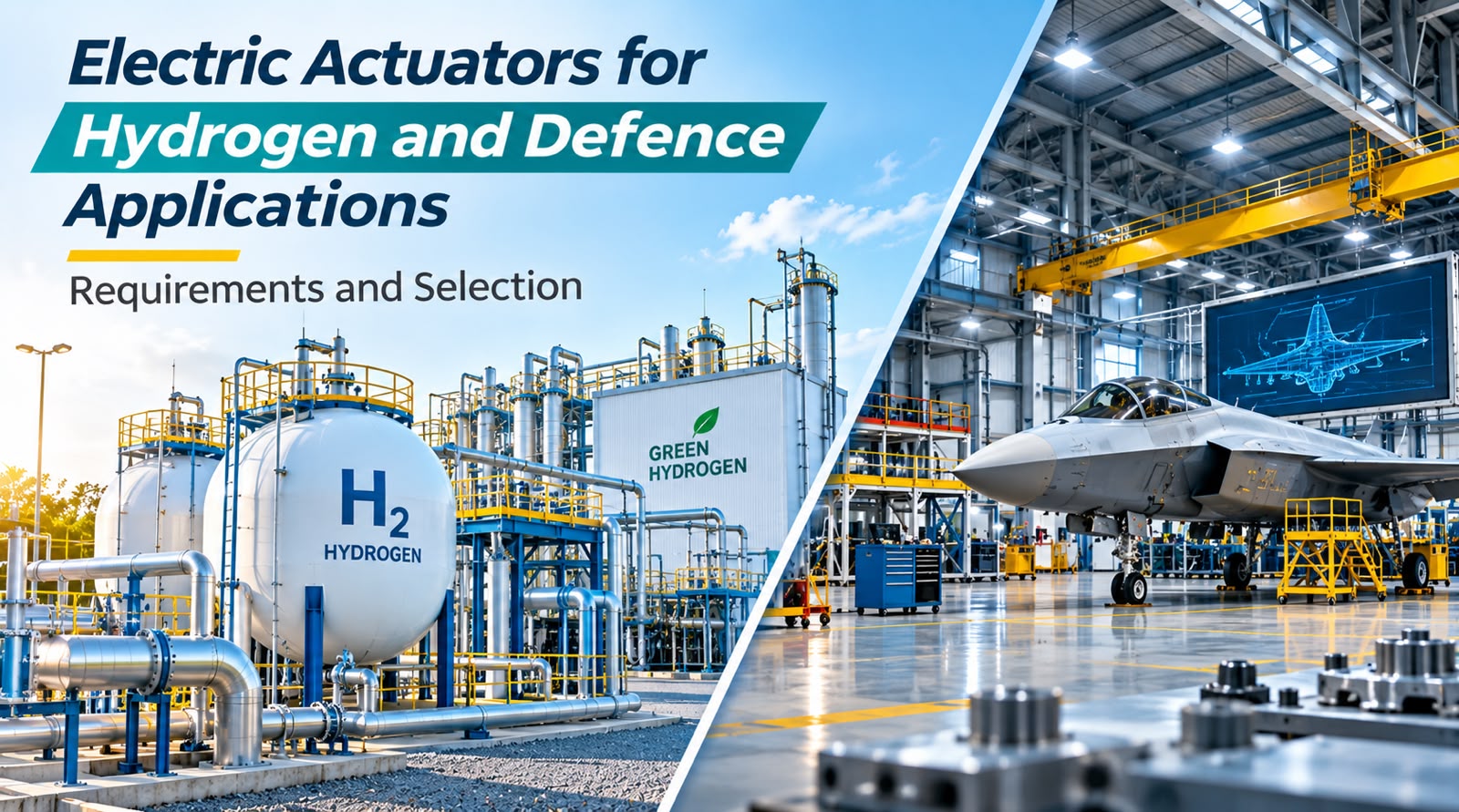
Electric Actuators for Hydrogen and Defence Applications: Requirements and Selection
Hydrogen infrastructure and defence manufacturing are two demanding sectors where equipment reliability, precision and operational safety are essential. Both industries use advanced mechanical systems, industrial pipelines, process equipment and automated control technologies to support critical operations.
As hydrogen production and distribution infrastructure expands, the need for reliable valve automation is increasing. Similarly, defence facilities require dependable automation equipment for specialized manufacturing, utility systems, testing facilities and other industrial operations.
Electric actuators play an important role in these environments by providing controlled mechanical movement for industrial valves and compatible equipment. They support remote operation, automated flow control and integration with industrial control systems.
However, selecting electric actuators for hydrogen and defence applications requires more than considering torque or operating speed. Engineers must evaluate hazardous-area requirements, environmental conditions, electrical specifications, control arrangements and project-specific standards.
In this guide, we explore the applications, requirements and selection considerations for electric actuators in hydrogen and defence industries.
1. What Are Electric Actuators for Hydrogen and Defence Applications?
Electric actuators are electromechanical devices that convert electrical energy into mechanical movement to operate valves and other compatible mechanisms.
In hydrogen infrastructure, they can automate valves used in production facilities, storage systems, pipeline networks and supporting process equipment.
In defence-related industrial applications, they can operate valves and mechanisms used in manufacturing facilities, utility systems, testing infrastructure and specialized process installations.
Depending on the application, electric actuators provide:
Quarter-turn movement
Multi-turn movement
Linear movement
On-off operation
Modulating control
Remote valve operation
The appropriate actuator depends on the valve configuration, operating requirements and environmental conditions.
2. Applications of Electric Actuators in the Hydrogen Industry
Hydrogen infrastructure involves production, purification, compression, storage, transportation and distribution.
Each stage requires suitable process equipment and carefully engineered control systems.
Electric actuators can automate compatible valves in different hydrogen-related installations.
A. Hydrogen Production Facilities
Hydrogen can be produced through several processes, including electrolysis and industrial reforming.
Production facilities use pipelines, isolation valves and supporting equipment to manage process fluids and gases.
Electric actuators may operate compatible valves in:
Process gas pipelines
Isolation arrangements
Utility systems
Supporting process equipment
Water supply systems for electrolysis facilities
The actuator and valve assembly must be suitable for the actual process conditions and installation classification.
B. Hydrogen Storage Systems
Hydrogen storage facilities use specialized equipment to store hydrogen under the required operating conditions.
Electric actuators may be used to operate compatible isolation and control valves associated with storage systems.
Important considerations include:
Operating pressure
Valve torque requirements
Process temperature
Material compatibility
Electrical equipment classification
Required operating and shutdown functions
Hydrogen storage applications require careful engineering because of hydrogen's physical properties and the potential consequences of leakage.
C. Hydrogen Pipeline Transportation
Hydrogen pipelines transport hydrogen between production facilities, storage installations and industrial users.
Electric actuators can automate compatible pipeline valves for isolation and flow-management operations.
Applications may include:
Pipeline isolation valves
Distribution network valves
Process connection valves
Supporting utility pipelines
Remote valve operation
Actuator selection must consider pipeline pressure, valve design, operating torque, required response time and the relevant safety requirements.
D. Hydrogen Refuelling Stations
Hydrogen refuelling stations use specialized equipment to transfer hydrogen into suitable storage systems.
Electric actuators may be considered for compatible supporting valves and utility systems.
However, equipment selection must follow the refuelling system's engineering design. Not every valve in a high-pressure hydrogen service is suitable for a conventional industrial electric actuator.
E. Green Hydrogen Projects
Green hydrogen projects use renewable electricity to produce hydrogen through water electrolysis.
These facilities involve electrolyzers, water treatment, gas separation, purification, compression and storage equipment.
Electric actuators can support automation in compatible water, utility and process valve systems.
Potential applications include:
Water treatment pipelines
Electrolyzer auxiliary systems
Cooling water circuits
Process isolation valves
Supporting utility equipment
The final actuator configuration must match the operating conditions and electrical safety requirements of the installation.
3. Applications of Electric Actuators in the Defence Industry
Defence-related facilities involve specialized manufacturing, engineering, testing and infrastructure operations.
Electric actuators can support industrial automation in suitable non-weaponized process and utility applications.
A. Defence Manufacturing Facilities
Defence manufacturing plants operate machinery, production utilities, ventilation systems and supporting process equipment.
Electric actuators can automate compatible valves and dampers used in:
Industrial utility pipelines
Cooling water systems
Air distribution networks
Process isolation
Supporting manufacturing equipment
B. Testing and Research Facilities
Specialized testing and research facilities may require controlled operation of fluid systems, ventilation equipment and utility infrastructure.
Electric actuators can provide remote operation and controlled positioning for compatible valves and mechanisms.
Selection depends on the facility's operating environment and technical requirements.
C. Industrial Cooling Systems
Cooling systems support machinery, testing equipment and specialized manufacturing processes.
Electric actuators may operate compatible valves installed in:
Cooling water pipelines
Heat exchanger circuits
Equipment isolation systems
Water distribution networks
D. Ventilation and Environmental Control
Ventilation is important in industrial manufacturing and testing facilities.
Electric actuators can operate compatible dampers and airflow-control mechanisms.
Depending on the application, quarter-turn or linear actuator configurations may be suitable.
E. Utility and Infrastructure Systems
Defence facilities also require reliable utility infrastructure for water, compressed air, fuel and other supporting services.
Electric actuators can automate compatible valves in these systems, subject to the relevant project specifications.
4. Critical Requirements for Hydrogen Electric Actuators
Hydrogen applications require careful consideration of safety, equipment construction and installation conditions.
A. Hazardous-Area Classification
Hydrogen can form flammable mixtures with air. Electrical equipment installed in classified hazardous locations must be suitable for the applicable area classification.
Engineers should evaluate:
Zone 0, Zone 1 or Zone 2 classification
Gas group requirements
Temperature class
Equipment protection level
Applicable certification
Installation and wiring requirements
Flameproof Ex d protection is one possible protection concept. However, the appropriate protection method must be selected according to the hazardous-area assessment.
An Ex d actuator should not automatically be assumed suitable for every hydrogen installation.
B. Hydrogen Material Compatibility
Hydrogen can create material-related challenges, including hydrogen embrittlement in susceptible materials under certain conditions.
The valve body, stem, seals, gaskets and other process-wetted components must be selected for the intended hydrogen service.
The actuator housing and external mechanical components must also suit the environmental conditions.
Importantly, actuator selection alone does not establish that the complete valve assembly is hydrogen-compatible.
C. Pressure and Temperature Conditions
Hydrogen systems can operate under demanding pressure and temperature conditions.
The actuator must provide the torque or thrust required by the selected valve under actual operating conditions.
Engineers should verify:
Maximum operating pressure
Differential pressure
Valve operating torque
Process temperature
Ambient temperature
Required operating time
D. Fail-Safe and Emergency Operation
Some hydrogen installations require specific emergency isolation or shutdown functions.
The required failure position, response time and power-loss behaviour must be defined by the system safety design.
A standard electric actuator should not be considered fail-safe simply because it has an electric motor and manual override.
Where emergency shutdown is required, the actuator and associated control system must be specifically engineered and qualified for that duty.
5. Critical Requirements for Defence Electric Actuators
Defence-related projects may have additional environmental, operational and documentation requirements.
A. Mechanical Durability
Equipment may be exposed to vibration, mechanical shock and demanding installation conditions.
Actuator mounting, housing strength and mechanical components should be evaluated against the project's environmental specifications.
B. Environmental Protection
Outdoor and industrial installations may involve:
Dust
Moisture
Temperature variations
Corrosion
Humidity
Exposure to harsh environmental conditions
The actuator's enclosure protection and construction must be suitable for the installation.
C. Electrical Compatibility
Defence projects may specify particular electrical supply and control requirements.
Engineers should verify voltage, frequency, current, electrical interfaces and control-system compatibility.
D. Control and Monitoring
Depending on the project, actuators may require:
Remote open and close commands
Position indication
Limit switch feedback
Modulating control
Local operation
Compatible communication interfaces
E. Documentation and Qualification
Some defence procurement projects require detailed documentation and product qualification.
Requirements may include:
Technical datasheets
Inspection and test documentation
Material certificates
Traceability records
Environmental test reports
Quality management documentation
Project-specific approvals
These requirements must be confirmed against the actual procurement specification. Industrial actuator certification should not be confused with defence-specific qualification.
6. Types of Electric Actuators Used in These Industries
Different valve configurations require different types of actuator movement.
A. Quarter-Turn Electric Actuators
Quarter-turn actuators provide approximately 90 degrees of rotary movement.
They are commonly used with:
Butterfly valves
Ball valves
Plug valves
Rotary dampers
They can be used in compatible hydrogen supporting systems, industrial utility pipelines and defence facility infrastructure.
B. Multi-Turn Electric Actuators
Multi-turn actuators provide multiple rotations of the output shaft.
They are commonly used with:
Gate valves
Globe valves with suitable multi-turn arrangements
Sluice gates
Other compatible multi-turn valves
They are suitable for applications requiring multiple rotations and specific torque output.
C. Linear Electric Actuators
Linear actuators provide straight-line movement.
They are commonly used with:
Globe valves
Diaphragm valves
Compatible control valves
Dosing equipment
Other linear mechanisms
The required thrust and stroke must be verified before selecting the actuator.
Explore the SDTORK Electric Actuator Range to review available actuator configurations.
7. Weatherproof vs Flameproof Electric Actuators
Selecting the correct enclosure and protection concept is particularly important in hydrogen-related installations.
Weatherproof Electric Actuators
Weatherproof actuators are designed to protect internal electrical and mechanical components against specified environmental exposure.
Depending on the model, protection ratings may include IP65, IP66, IP67 or IP68.
These ratings describe protection against dust and water ingress under defined test conditions. They do not establish explosion protection.
Flameproof Electric Actuators
Flameproof Ex d actuators are designed according to applicable explosion-protection requirements.
Their enclosure is intended to contain an internal explosion and prevent ignition of the surrounding explosive atmosphere, when correctly certified and installed.
Selection must consider:
Gas group
Temperature class
Zone classification
Equipment protection level
Certificate validity
Cable glands and accessories
Installation requirements
SDTORK offers FSD-1001-Ex and FSD-12000 flameproof actuator configurations in its published product portfolio.
Explore the SDTORK Flameproof Electric Actuator Range.
8. How to Select the Right Electric Actuator for Hydrogen and Defence Applications
Selecting an actuator for these industries requires a structured technical evaluation.
1. Identify the Valve Type
Determine whether the application requires a quarter-turn, multi-turn or linear actuator.
2. Calculate Torque or Thrust
The actuator must provide sufficient operating force for the valve under actual process conditions.
Consider:
Valve size and construction
Differential pressure
Seating and unseating torque
Operating friction
Mechanical losses
Required safety margin
For a detailed explanation, read our guide on How to Select and Size an Electric Actuator: Torque Calculation Guide.
3. Verify Hazardous-Area Requirements
For hydrogen installations, establish the hazardous-area classification and verify the actuator's exact protection certification.
Do not select equipment solely because the product description mentions flameproof or explosion-proof construction.
4. Evaluate Material Compatibility
Confirm that all process-wetted components are suitable for hydrogen or the relevant process medium.
5. Check Environmental Conditions
Consider ambient temperature, moisture, dust, corrosion, vibration and other installation-specific conditions.
6. Confirm Control Requirements
Establish whether the system requires on-off, inching, modulating or emergency isolation operation.
7. Verify Electrical Specifications
Check voltage, phase, frequency, current and wiring requirements.
8. Review Project Certifications
Verify the required product certificates, inspection documents and applicable industry standards before final selection.
9. Why Choose SDTORK Electric Actuators for Hydrogen and Defence Applications?
SDTORK Controls Pvt. Ltd. manufactures electric actuators for industrial valve automation across different process industries.
Its published portfolio includes:
Quarter-turn electric actuators
Multi-turn electric actuators
Linear electric actuators
Weatherproof configurations
Flameproof actuator configurations
Relevant product families include:
FSD-1001-Ex Series: Flameproof Ex d quarter-turn electric actuators available in different torque configurations.
FSD-12000 Series: Multi-turn flameproof electric actuator configurations for compatible valve applications.
SD-3000 Series: Multi-turn weatherproof electric actuators for industrial process applications.
SD-1001 Series: Quarter-turn electric actuators for compatible industrial valves.
SD-2000 Series: Linear electric actuators for compatible globe valves, diaphragm valves and dosing pumps.
For hydrogen-related installations, the exact model certification, gas group, temperature class and installation suitability must be verified.
For defence-related projects, environmental qualifications and project-specific approvals must also be confirmed.
Explore SDTORK's industry solutions:
10. Frequently Asked Questions
Are electric actuators used in hydrogen applications?
Yes. Electric actuators can operate compatible valves in hydrogen production, storage, transportation and supporting utility systems. The equipment must be suitable for the process conditions and installation classification.
What type of electric actuator is suitable for hydrogen pipelines?
The choice depends on the pipeline valve. Quarter-turn actuators are suitable for compatible ball and butterfly valves, while multi-turn actuators are used with compatible gate valves and other multi-turn arrangements.
Are flameproof electric actuators required for hydrogen plants?
Not everywhere. The requirement depends on the hazardous-area classification and the applicable equipment protection standards.
What is an Ex d electric actuator?
An Ex d electric actuator uses a flameproof enclosure designed to contain an internal explosion and prevent ignition of the surrounding explosive atmosphere under its certified conditions.
What should be considered when selecting actuators for hydrogen service?
Important considerations include hazardous-area classification, gas group, temperature class, valve torque, pressure, process materials, electrical supply and control requirements.
Where are electric actuators used in the defence industry?
They can be used in industrial manufacturing facilities, utility pipelines, cooling systems, ventilation arrangements and compatible testing infrastructure.
Can electric actuators integrate with PLC and SCADA systems?
Yes. Compatible models can integrate with industrial automation systems through suitable control interfaces, feedback arrangements and communication options.
Does a weatherproof actuator provide explosion protection?
No. Weatherproof protection ratings such as IP66 and IP68 address ingress protection. They do not independently establish hazardous-area explosion protection.
Conclusion
Hydrogen infrastructure and defence manufacturing require dependable automation equipment that meets demanding technical and environmental requirements.
Electric actuators support these industries by automating compatible valves and mechanisms across production facilities, storage systems, pipeline networks, industrial utilities and specialized infrastructure.
However, successful selection requires more than choosing an actuator based on torque or movement. Engineers must evaluate hazardous-area classification, material compatibility, environmental protection, control requirements and project-specific qualifications.
With the right actuator configuration and appropriate engineering verification, industrial electric actuators can support reliable valve automation across hydrogen and defence-related applications.
Looking for electric actuators for hydrogen or defence industry applications?
Explore SDTORK Hydrogen & Green Energy Solutions and SDTORK Defence & Aerospace Solutions.
Contact SDTORK Controls Pvt. Ltd. to discuss your valve type, torque requirements, environmental conditions and project specifications.
Related Posts
- Nov 30, 2026
- SDTORK
- 10
Electric Actuator Price in India: Factors Affecting Cost and Selection
Explore More
- Nov 23, 2026
- SDTORK
- 10